Aircraft mechanics around the world read maintenance instructions in English. Many of them do not speak English as their first language. If a mechanic reads an instruction incorrectly, an accident can occur.
In 1979, the European airline industry (AECMA) started to work on a solution. The result is ASD-STE100, Simplified Technical English (STE). Andrej Karpathy posted about it on X. This page gives a short summary.
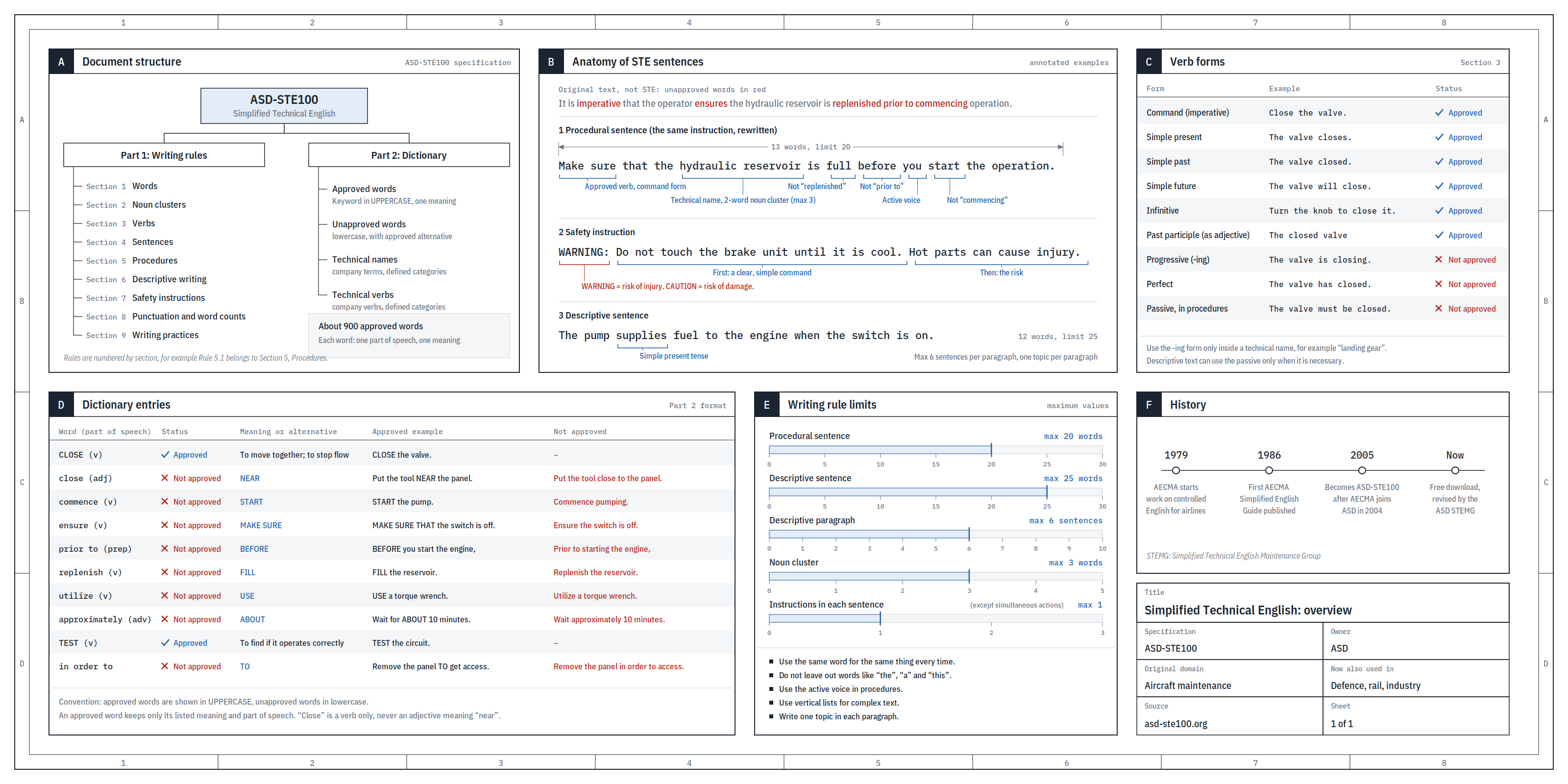
Two parts
STE has two parts:
- Writing rules. For example: write short sentences, use the active voice, and give one instruction in each sentence.
- A dictionary. It has approximately 900 approved words. Each word has one meaning and one part of speech.
One word, one meaning
In STE, “close” is a verb only. “Close the valve” is correct. “Put the tool close to the panel” is not correct. Use “near”.
Many common words are not approved. The dictionary gives an approved word to use:
| Not approved | Use |
|---|---|
| utilize | use |
| commence | start |
| ensure | make sure |
| prior to | before |
| replenish | fill |
| approximately | about |
| in order to | to |
The main rules
- A procedural sentence has a maximum of 20 words. A descriptive sentence has a maximum of 25 words.
- A paragraph has a maximum of 6 sentences and one topic.
- A noun cluster has a maximum of 3 words.
- Each sentence gives one instruction. The exception is two actions that you do at the same time.
- Use the active voice in procedures.
- Use simple tenses. “The valve closes” is correct. “The valve is closing” and “The valve has closed” are not correct.
- Use the same word for the same thing each time.
- Do not remove small words such as “the”, “a” and “this”.
Before and after
Here are three examples from our own work.
1. A deploy instruction
Before:
Prior to deploying, it is essential that you ensure all of the environment variables have been properly configured, otherwise the application may fail to initialize correctly.
After:
Before you deploy, make sure that each environment variable has a value. If a variable has no value, the application can fail when it starts.
The “after” text has two short sentences. “Prior to”, “ensure” and the perfect tense (“have been configured”) are not approved.
2. An error message
Before:
Utilizing an invalid API key will result in the request being rejected by the server.
After:
If the API key is incorrect, the server does not accept the request.
The “after” sentence uses the active voice. The reader can see the cause and the result immediately.
3. A prompt for an AI model
Before:
You should be summarizing the document while making sure you’re keeping it concise and also highlighting any risks that might have been mentioned.
After:
Summarize the document in 5 sentences or fewer. Then, make a list of the risks in the document.
The “before” prompt has three instructions in one sentence. The “after” prompt gives one instruction in each sentence. It also uses a number in place of “concise”, so you can check the result.
Why we use it
We build software with AI models every day. STE helps us in three areas:
- Prompts. A prompt with short sentences and one instruction in each sentence is easy to check. If the model does an incorrect thing, you can find the sentence that caused the problem.
- Output. We tell models to write their answers in STE. The answers are shorter and easier to scan.
- Translation. People and machines translate STE text more easily. Fewer meanings give fewer errors.
Try it
The specification is free. You can download it from asd-ste100.org. Start with three rules: write short sentences, use the active voice, and use one word for one thing.
We wrote this post with the STE rules. We did not check each word against the STE dictionary.